
Month-end close automation
Faster close. Accurate statements. Finance teams freed from manual work.
Month-end close is one of the most high-pressure, time-intensive processes in any finance department — data collected from multiple disconnected systems, reconciliations performed manually, journal entries re-keyed, and financial statements assembled under tight deadlines. Automated, it becomes a structured, reliable workflow: data aggregated automatically, reconciliations run in real time, and reports generated without the manual effort that turns month-end into a crisis.
Manual vs automated month-end close
Most finance teams still close the books through a combination of manual data exports, spreadsheet reconciliations, and email-based sign-off chains — making month-end a recurring source of stress, errors, and delays.
Without automation
What the manual process typically looks like
- Financial data collected manually from multiple systems — accounting software, ERP, spreadsheets — prone to gaps and inconsistencies
- Reconciliations performed manually across accounts — time-consuming and often incomplete by deadline
- Adjusting journal entries created and posted manually — repetitive data entry with high error risk
- Financial statements compiled manually from reconciled data — formatting inconsistent and subject to human error
- Compliance checks performed ad hoc — audit preparation left to the last minute
- Close cycle takes days or weeks — leaving little time for analysis and strategic decision-making
With automation
What changes when you automate
- Financial data aggregated automatically from all source systems into a centralised repository
- Reconciliations run automatically — discrepancies flagged and resolved without manual cross-referencing
- Recurring journal entries created and posted automatically — eliminating repetitive data entry
- Financial statements generated automatically from reconciled data — consistent formatting every period
- Compliance checks automated — audit trail maintained throughout the close cycle
- Close cycle shortened significantly — finance teams freed to focus on analysis rather than data handling
Exclusive content
Access the full use case
Fill in the form to unlock this resource — no spam, only content relevant to your operations.
Month-end close automation
Faster close. Accurate statements. Finance teams freed from manual work.
Month-end close is one of the most high-pressure, time-intensive processes in any finance department — data collected from multiple disconnected systems, reconciliations performed manually, journal entries re-keyed, and financial statements assembled under tight deadlines. Automated, it becomes a structured, reliable workflow: data aggregated automatically, reconciliations run in real time, and reports generated without the manual effort that turns month-end into a crisis.
Manual vs automated month-end close
Most finance teams still close the books through a combination of manual data exports, spreadsheet reconciliations, and email-based sign-off chains — making month-end a recurring source of stress, errors, and delays.
Without automation
What the manual process typically looks like
- Financial data collected manually from multiple systems — accounting software, ERP, spreadsheets — prone to gaps and inconsistencies
- Reconciliations performed manually across accounts — time-consuming and often incomplete by deadline
- Adjusting journal entries created and posted manually — repetitive data entry with high error risk
- Financial statements compiled manually from reconciled data — formatting inconsistent and subject to human error
- Compliance checks performed ad hoc — audit preparation left to the last minute
- Close cycle takes days or weeks — leaving little time for analysis and strategic decision-making
With automation
What changes when you automate
- Financial data aggregated automatically from all source systems into a centralised repository
- Reconciliations run automatically — discrepancies flagged and resolved without manual cross-referencing
- Recurring journal entries created and posted automatically — eliminating repetitive data entry
- Financial statements generated automatically from reconciled data — consistent formatting every period
- Compliance checks automated — audit trail maintained throughout the close cycle
- Close cycle shortened significantly — finance teams freed to focus on analysis rather than data handling
What month-end close involves
Month-end close is the series of tasks undertaken by finance departments to close out financial records and prepare financial statements at the end of each accounting period. It involves collecting financial data from multiple sources, performing reconciliations across accounts, making necessary adjusting entries, compiling financial statements, analysing performance, and ensuring compliance with regulatory requirements and internal policies.
The accuracy and timeliness of month-end close directly determines the quality of financial reporting available to leadership for decision-making. Done manually, the process is slow, error-prone, and heavily dependent on individual team members’ knowledge of disconnected systems. Automated, it delivers faster closes, more accurate statements, and audit-ready documentation — every period, without the recurring manual effort.
The month-end close workflow
From data collection to compliance sign-off — every step of the process, mapped end to end.
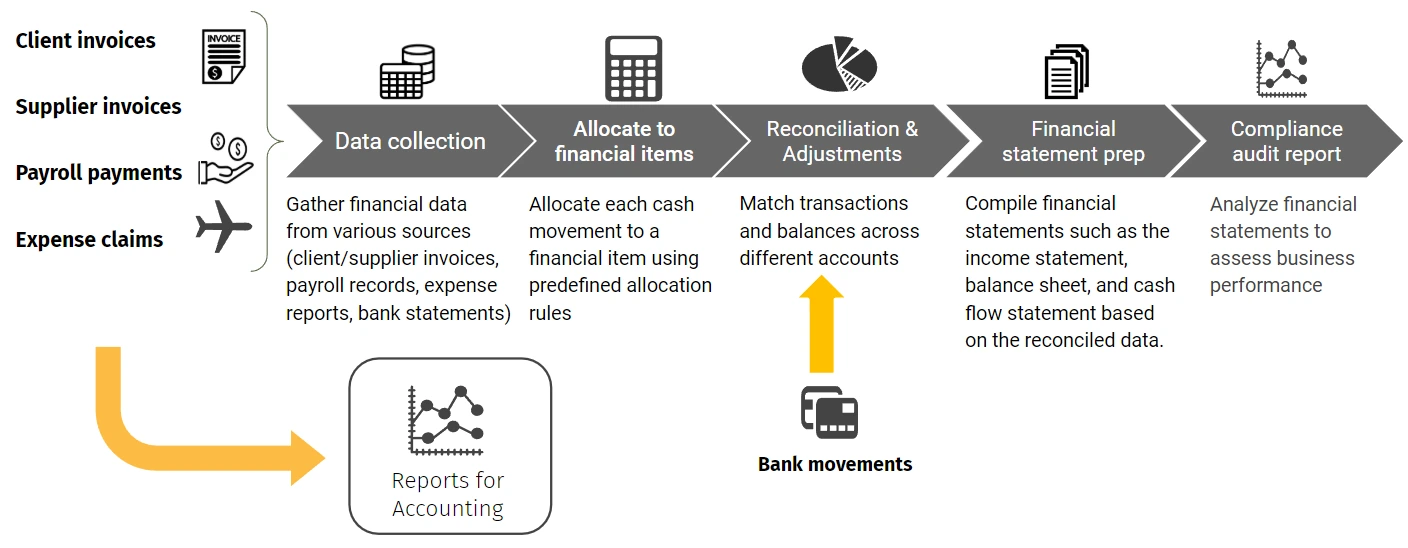
How automation improves the month-end close process
Every close follows the same verified sequence — data collected automatically, reconciliations run without manual effort, statements generated consistently, and compliance maintained throughout. Faster every period, accurate every time.
Automated data collection & aggregation
BPA solutions retrieve financial data automatically from all source systems — accounting software, ERP, bank statements, expense systems, payroll — and consolidate it into a centralised repository. No manual exports, no copy-paste between spreadsheets, no gaps from systems that were missed in the collection cycle.
Automated reconciliation & discrepancy resolution
Reconciliations — bank accounts, accounts receivable, accounts payable, inventory — are run automatically against supporting documentation. Discrepancies are flagged and routed to the responsible team member for resolution, with the reconciliation status tracked in real time across all accounts simultaneously.
Automated journal entries
Recurring journal entries — accruals, prepayments, depreciation, and other period-end adjustments — are created and posted automatically based on predefined rules. Repetitive data entry is eliminated entirely, and the general ledger is updated consistently and accurately without manual intervention from the accounting team.
Automated financial statement preparation
Financial statements — income statement, balance sheet, and cash flow statement — are generated automatically from the reconciled data. Consistent formatting is applied every period, variance analysis reports and management dashboards are produced automatically, and finance teams receive timely insights without manual compilation effort.
Automated financial analysis & reporting
Performance analysis — variance reports, trend analysis, and KPI dashboards — is generated automatically based on the period’s financial data. Stakeholders receive timely, consistent reporting without waiting for finance teams to compile results manually, enabling faster and better-informed decision-making.
Automated compliance & audit readiness
Compliance checks — regulatory reporting, tax filing requirements, internal policy adherence — are run automatically throughout the close cycle. Documentation management workflows ensure that all required evidence is captured and organised. A complete audit trail is maintained automatically, making audit preparation a continuous process rather than a last-minute effort.
Based on industry benchmarks for finance process automation. Actual results vary by organisation.
Other finance automation use cases
Ready to transform your operations?
Schedule a free consultation with our automation specialists.
We’ll analyze your current processes and show you exactly where automation can make the biggest impact.
No commitment. No generic demos. Just a real conversation about your operation.
FREE BPA CONSULTATION
Find out where automation can make the biggest impact on your operations
In a free 30-minute session, one of our certified BPA consultants will analyse your current back-office workflows and show you exactly where automation can reduce costs, eliminate manual effort, and strengthen compliance — with no commitment and no generic demos.