
Contract review automation
Contracts reviewed faster. Risks flagged automatically. Nothing missed.
Contract review is one of the most time-intensive and risk-exposed processes in any legal or procurement function. Reviewed manually, contracts sit in queues, key clauses are missed, compliance risks go undetected, and version control becomes a liability. Automated, it becomes a structured workflow — from document intake and IDP analysis to compliance monitoring, risk assessment, approval routing, and centralised lifecycle management — with every obligation tracked and every risk surfaced before signing.
Manual vs automated contract review
Most organisations still review contracts through manual reading, email-based redlining, and informal risk assessment — creating bottlenecks, missed obligations, and compliance exposure that compounds with contract volume.
Without automation
What the manual process typically looks like
- Contracts received by email — manually assigned to reviewers with no centralised tracking
- Key terms, obligations, and deadlines identified through manual reading — inconsistent and time-consuming
- Compliance checks performed ad hoc — regulatory changes rarely reflected in review criteria
- Risk assessment done informally — financial and legal liabilities often not surfaced until post-signature
- Negotiation and approval managed by email — version control unreliable and sign-off chain slow
- Executed contracts stored in disparate systems — expiration dates and renewal windows frequently missed
With automation
What changes when you automate
- Contracts captured automatically and routed to the appropriate reviewer based on type and counterparty
- IDP extracts key terms, obligations, payment terms, and deadlines automatically — no manual reading required
- Compliance checks triggered automatically — deviations from standard clauses flagged for legal review
- Risk scoring applied automatically — high-risk clauses and financial liabilities surfaced before negotiation
- Approval workflows structured and tracked — versions controlled, sign-off chain enforced automatically
- Executed contracts stored centrally with automated alerts for renewals, expirations, and key milestones
Exclusive content
Access the full use case
Fill in the form to unlock this resource — no spam, only content relevant to your operations.
Contract review automation
Contracts reviewed faster. Risks flagged automatically. Nothing missed.
Contract review is one of the most time-intensive and risk-exposed processes in any legal or procurement function. Reviewed manually, contracts sit in queues, key clauses are missed, compliance risks go undetected, and version control becomes a liability. Automated, it becomes a structured workflow — from document intake and IDP analysis to compliance monitoring, risk assessment, approval routing, and centralised lifecycle management — with every obligation tracked and every risk surfaced before signing.
Manual vs automated contract review
Most organisations still review contracts through manual reading, email-based redlining, and informal risk assessment — creating bottlenecks, missed obligations, and compliance exposure that compounds with contract volume.
Without automation
What the manual process typically looks like
- Contracts received by email — manually assigned to reviewers with no centralised tracking
- Key terms, obligations, and deadlines identified through manual reading — inconsistent and time-consuming
- Compliance checks performed ad hoc — regulatory changes rarely reflected in review criteria
- Risk assessment done informally — financial and legal liabilities often not surfaced until post-signature
- Negotiation and approval managed by email — version control unreliable and sign-off chain slow
- Executed contracts stored in disparate systems — expiration dates and renewal windows frequently missed
With automation
What changes when you automate
- Contracts captured automatically and routed to the appropriate reviewer based on type and counterparty
- IDP extracts key terms, obligations, payment terms, and deadlines automatically — no manual reading required
- Compliance checks triggered automatically — deviations from standard clauses flagged for legal review
- Risk scoring applied automatically — high-risk clauses and financial liabilities surfaced before negotiation
- Approval workflows structured and tracked — versions controlled, sign-off chain enforced automatically
- Executed contracts stored centrally with automated alerts for renewals, expirations, and key milestones
What contract review involves
Client and supplier contract review is the process in which legal teams or contract managers examine agreements proposed by clients or suppliers — analysing terms, conditions, and legal implications to ensure alignment with organisational policies, regulatory requirements, and risk management strategies. It covers the full lifecycle from initial intake through review and analysis, compliance and risk assessment, negotiation, approval, execution, and ongoing contract management.
The volume and complexity of contracts in most organisations makes manual review a significant bottleneck. Each contract contains dozens of clauses that must be checked against internal standards, regulatory requirements, and risk thresholds — a process that is slow, inconsistent, and heavily dependent on individual expertise. Automated with IDP and BPA, the same review cycle runs faster, more consistently, and with a complete audit trail from first receipt to final execution.
The contract review workflow
From contract intake to execution and lifecycle management — every step of the process, mapped end to end.
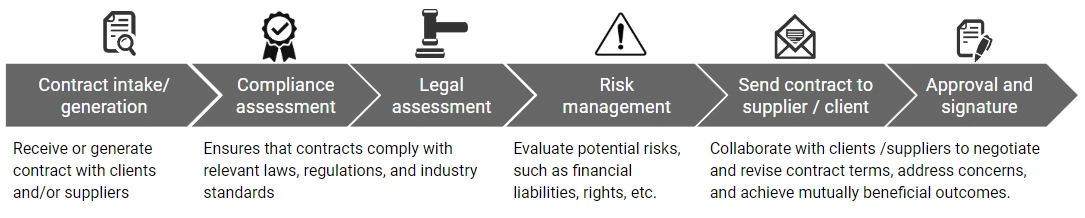
How automation improves the contract review process
Every contract follows the same verified review path — analysed by IDP, checked for compliance, scored for risk, routed for approval, and managed throughout its lifecycle. Faster reviews, fewer risks, nothing missed.
Automated document intake & routing
BPA solutions capture incoming contracts automatically from email, document management systems, or client portals — routing them to the appropriate reviewer based on contract type, counterparty, and value. Review queues are centralised and tracked in real time, eliminating the manual assignment and status-tracking that slow down high-volume contract operations.
IDP contract analysis & data extraction
Intelligent Document Processing extracts and analyses key contract data automatically — including pricing, deliverables, payment terms, termination clauses, and legal obligations. This eliminates manual reading of repetitive standard clauses, surfaces the terms that require human attention, and significantly reduces the time each reviewer spends per contract.
Automated compliance monitoring
Compliance checks are run automatically against current legal and regulatory requirements — data privacy laws, industry-specific regulations, and internal policy standards. Deviations from approved clause language are flagged automatically for legal review, and compliance monitoring continues post-execution as regulations evolve, ensuring contracts remain compliant over their full lifetime.
Automated risk assessment & scoring
RPA analyses contract terms automatically against predefined risk parameters — financial liabilities, intellectual property provisions, indemnification clauses, and dispute resolution mechanisms. High-risk clauses are scored and flagged for escalation, enabling legal and procurement teams to prioritise their attention on the contracts that present the greatest organisational exposure.
Structured approval workflows & version control
Contract approvals are routed automatically to the correct stakeholders — legal counsel, senior management, or procurement — based on contract type and value. Version control is enforced automatically throughout negotiation and revision cycles. All parties are notified of required actions in real time, with a complete, timestamped record of every change and sign-off maintained automatically.
Automated contract lifecycle management
Executed contracts are stored automatically in a centralised repository — searchable, versioned, and linked to counterparty records. Automated alerts are triggered for upcoming renewals, expiration dates, and key contractual milestones, ensuring that no obligation is missed and no contract silently lapses without a decision being made.
Based on industry benchmarks for legal process automation. Actual results vary by organisation.
Other legal automation use cases
Ready to transform your operations?
Schedule a free consultation with our automation specialists.
We’ll analyze your current processes and show you exactly where automation can make the biggest impact.
No commitment. No generic demos. Just a real conversation about your operation.
FREE BPA CONSULTATION
Find out where automation can make the biggest impact on your operations
In a free 30-minute session, one of our certified BPA consultants will analyse your current back-office workflows and show you exactly where automation can reduce costs, eliminate manual effort, and strengthen compliance — with no commitment and no generic demos.