
Supplier homologation automation
Suppliers evaluated faster. Compliance verified automatically. Partnerships built on solid ground.
Supplier homologation — the formal process of evaluating and approving new suppliers before engaging in business — is critical for protecting your organisation from supply chain risk, regulatory exposure, and quality failures. Managed manually, it is slow, inconsistent, and heavily dependent on individual reviewers. Automated, it becomes a standardised, fully traceable workflow: from supplier identification and document collection to compliance evaluation, risk scoring, approval, and ongoing performance monitoring.
Manual vs automated supplier homologation
Most organisations still manage supplier evaluation through manual document requests, spreadsheet-based scoring, and informal approval processes — creating delays, inconsistent assessments, and undetected compliance risks in the supply chain.
Without automation
What the manual process typically looks like
- Supplier identification done informally — no standardised criteria or structured market assessment
- Document requests sent by email — follow-up manual, collection incomplete, and validation inconsistent
- Compliance evaluation performed manually — regulatory requirements checked ad hoc and inconsistently across suppliers
- Quality and risk assessment based on individual judgment — no standardised scoring or escalation criteria
- Approval process managed informally — no structured workflow, sign-off trail, or visibility into status
- Post-approval performance monitoring done sporadically — supplier issues often discovered reactively
With automation
What changes when you automate
- Supplier identification structured with standardised criteria — market data integrated and assessed automatically
- Document requests sent automatically — submissions tracked, completeness validated by IDP, missing items chased
- Compliance evaluation run automatically against current regulatory standards — deviations flagged for review
- Risk and quality scoring applied consistently through automated criteria — high-risk suppliers escalated automatically
- Approval workflow structured and tracked — sign-off routed correctly, status visible in real time
- Supplier performance monitored automatically post-approval — alerts triggered for SLA breaches or quality issues
Exclusive content
Access the full use case
Fill in the form to unlock this resource — no spam, only content relevant to your operations.
Supplier homologation automation
Suppliers evaluated faster. Compliance verified automatically. Partnerships built on solid ground.
Supplier homologation — the formal process of evaluating and approving new suppliers before engaging in business — is critical for protecting your organisation from supply chain risk, regulatory exposure, and quality failures. Managed manually, it is slow, inconsistent, and heavily dependent on individual reviewers. Automated, it becomes a standardised, fully traceable workflow: from supplier identification and document collection to compliance evaluation, risk scoring, approval, and ongoing performance monitoring.
Manual vs automated supplier homologation
Most organisations still manage supplier evaluation through manual document requests, spreadsheet-based scoring, and informal approval processes — creating delays, inconsistent assessments, and undetected compliance risks in the supply chain.
Without automation
What the manual process typically looks like
- Supplier identification done informally — no standardised criteria or structured market assessment
- Document requests sent by email — follow-up manual, collection incomplete, and validation inconsistent
- Compliance evaluation performed manually — regulatory requirements checked ad hoc and inconsistently across suppliers
- Quality and risk assessment based on individual judgment — no standardised scoring or escalation criteria
- Approval process managed informally — no structured workflow, sign-off trail, or visibility into status
- Post-approval performance monitoring done sporadically — supplier issues often discovered reactively
With automation
What changes when you automate
- Supplier identification structured with standardised criteria — market data integrated and assessed automatically
- Document requests sent automatically — submissions tracked, completeness validated by IDP, missing items chased
- Compliance evaluation run automatically against current regulatory standards — deviations flagged for review
- Risk and quality scoring applied consistently through automated criteria — high-risk suppliers escalated automatically
- Approval workflow structured and tracked — sign-off routed correctly, status visible in real time
- Supplier performance monitored automatically post-approval — alerts triggered for SLA breaches or quality issues
What supplier homologation involves
Supplier homologation is the formal process of evaluating and approving potential suppliers before engaging in business transactions. It ensures that suppliers meet stringent criteria in terms of reliability, financial stability, quality management, and compliance with regulatory standards and industry requirements. The process spans supplier identification, preliminary screening, documentation collection and verification, compliance and quality evaluation, risk assessment, formal approval and onboarding, and ongoing performance monitoring.
For organisations with complex supply chains or strict regulatory obligations — particularly in banking, financial services, and regulated industries — homologation is not optional. A poorly vetted supplier represents operational, financial, and reputational risk. Automated, the process delivers consistent, defensible supplier evaluations that protect the organisation and create a scalable foundation for supply chain governance.
The supplier homologation workflow
From supplier identification to approval and ongoing performance monitoring — every step of the process, mapped end to end.
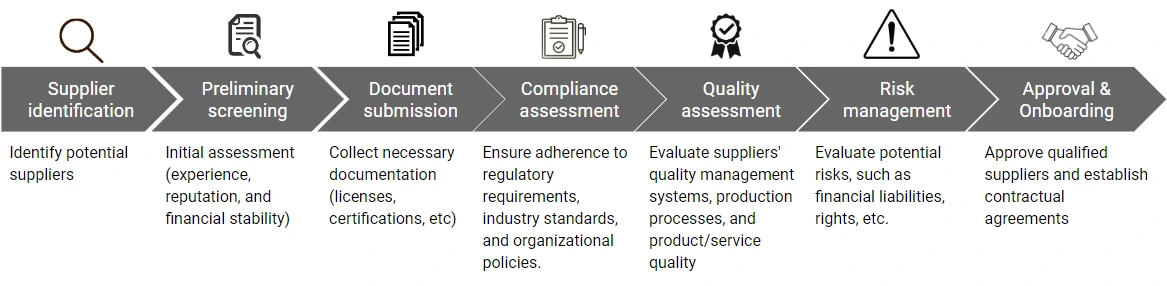
How automation improves the supplier homologation process
Every supplier candidate follows the same verified evaluation path — documents collected and processed by IDP, compliance checked automatically, risk scored consistently, approved through a structured workflow, and monitored continuously post-approval.
Automated workflow routing & task tracking
BPA automates the routing and approval of homologation requests — notifying the relevant stakeholders automatically at each stage and tracking task completion in real time. Procurement, compliance, and legal teams all work within a single structured workflow, eliminating the ad hoc coordination that slows manual homologation processes.
Automated document management & IDP verification
IDP solutions automate the collection, processing, and verification of supplier documentation — licences, certifications, financial statements, and compliance certificates. Completeness checks are run automatically, missing documents are chased without manual intervention, and extracted data is validated against evaluation criteria before any human reviewer sees the file.
Automated data extraction & supplier scoring
RPA and IDP extract and analyse data from supplier documents and systems automatically — financial indicators, quality certifications, regulatory standing, and operational capacity — enabling consistent, data-driven scoring across all supplier candidates. Manual interpretation is reserved for borderline cases, not every evaluation.
Automated compliance monitoring & regulatory checks
BPA tracks changes in regulatory requirements automatically — updating assessment criteria and generating compliance reports when standards change. Supplier compliance is re-evaluated continuously, not just at the point of initial approval, ensuring that the supplier base remains compliant as the regulatory environment evolves.
Structured approval & supplier onboarding
Approved suppliers are onboarded automatically — contractual agreements, SLA frameworks, and system access configured through structured workflows with no manual coordination required. All parties are notified automatically at each stage, and the complete onboarding record is maintained for audit purposes from the first contact to contract execution.
Automated supplier performance monitoring
Post-approval, supplier performance metrics — delivery timeliness, quality indicators, SLA adherence — are tracked automatically against agreed benchmarks. Alerts are triggered automatically when performance deviates from acceptable thresholds, enabling proactive supplier management rather than reactive issue resolution after the damage is done.
Based on industry benchmarks for legal and procurement process automation. Actual results vary by organisation.
Other legal automation use cases
Ready to transform your operations?
Schedule a free consultation with our automation specialists.
We’ll analyze your current processes and show you exactly where automation can make the biggest impact.
No commitment. No generic demos. Just a real conversation about your operation.
FREE BPA CONSULTATION
Find out where automation can make the biggest impact on your operations
In a free 30-minute session, one of our certified BPA consultants will analyse your current back-office workflows and show you exactly where automation can reduce costs, eliminate manual effort, and strengthen compliance — with no commitment and no generic demos.