
Employee onboarding automation
New hires ready faster. Documentation handled automatically. Nothing missed.
Employee onboarding is the process that determines whether a new hire becomes productive and engaged — or frustrated and uncertain from day one. Managed manually, it means scattered paperwork, forgotten system access requests, inconsistent orientation, and coordination overhead across HR, IT, and line managers. Automated, it becomes a structured, personalised workflow that triggers automatically at offer acceptance — covering documentation, compliance, access provisioning, training, and integration with HR systems, all without manual coordination.
Manual vs automated employee onboarding
Most organisations still manage onboarding through a combination of paper forms, email chains between HR, IT, and managers, and informal checklists — creating delays, inconsistency, and poor first impressions for new hires.
Without automation
What the manual process typically looks like
- Onboarding triggered manually after offer acceptance — coordination between HR, IT, and managers ad hoc
- Paperwork completed on paper or via email — manual data entry, errors common, documents frequently missing
- IT access requests submitted separately — new hires often start without the systems they need
- Training and orientation scheduled manually — inconsistent experience depending on department and manager
- HR masterdata entered manually into multiple systems — duplicate entry and data inconsistencies common
- No visibility into onboarding completion — tasks fall through the cracks without automated tracking
With automation
What changes when you automate
- Onboarding workflow triggered automatically at offer acceptance — all teams notified and tasks assigned instantly
- Onboarding documents generated and distributed electronically — e-signed and stored without manual handling
- IT access provisioned automatically based on role — new hire arrives with all required systems ready
- Personalised onboarding plan generated automatically — training modules, orientation sessions, and checklists tailored to role
- HR masterdata synchronised automatically across all systems — single data entry, no duplicates
- Onboarding progress tracked in real time — automated reminders for pending tasks sent to relevant stakeholders
Exclusive content
Access the full use case
Fill in the form to unlock this resource — no spam, only content relevant to your operations.
Employee onboarding automation
New hires ready faster. Documentation handled automatically. Nothing missed.
Employee onboarding is the process that determines whether a new hire becomes productive and engaged — or frustrated and uncertain from day one. Managed manually, it means scattered paperwork, forgotten system access requests, inconsistent orientation, and coordination overhead across HR, IT, and line managers. Automated, it becomes a structured, personalised workflow that triggers automatically at offer acceptance — covering documentation, compliance, access provisioning, training, and integration with HR systems, all without manual coordination.
Manual vs automated employee onboarding
Most organisations still manage onboarding through a combination of paper forms, email chains between HR, IT, and managers, and informal checklists — creating delays, inconsistency, and poor first impressions for new hires.
Without automation
What the manual process typically looks like
- Onboarding triggered manually after offer acceptance — coordination between HR, IT, and managers ad hoc
- Paperwork completed on paper or via email — manual data entry, errors common, documents frequently missing
- IT access requests submitted separately — new hires often start without the systems they need
- Training and orientation scheduled manually — inconsistent experience depending on department and manager
- HR masterdata entered manually into multiple systems — duplicate entry and data inconsistencies common
- No visibility into onboarding completion — tasks fall through the cracks without automated tracking
With automation
What changes when you automate
- Onboarding workflow triggered automatically at offer acceptance — all teams notified and tasks assigned instantly
- Onboarding documents generated and distributed electronically — e-signed and stored without manual handling
- IT access provisioned automatically based on role — new hire arrives with all required systems ready
- Personalised onboarding plan generated automatically — training modules, orientation sessions, and checklists tailored to role
- HR masterdata synchronised automatically across all systems — single data entry, no duplicates
- Onboarding progress tracked in real time — automated reminders for pending tasks sent to relevant stakeholders
What employee onboarding involves
Employee onboarding is more than paperwork and orientation — it is the critical process of integrating new hires into your organisation and preparing them for success in their roles. It encompasses administrative tasks such as completing employment documentation and setting up system access, as well as cultural assimilation, structured training, and the coordination of inputs from HR, IT, the line manager, and the new hire themselves.
The quality of the onboarding experience directly affects new hire retention, time to productivity, and long-term engagement. Organisations with structured, automated onboarding processes see significantly faster ramp-up times and lower early attrition. Automated with BPA and IDP, onboarding becomes a consistent, professional experience — regardless of which team or manager a new hire joins.
The employee onboarding workflow
From offer acceptance to fully integrated employee — every step of the process, mapped end to end.
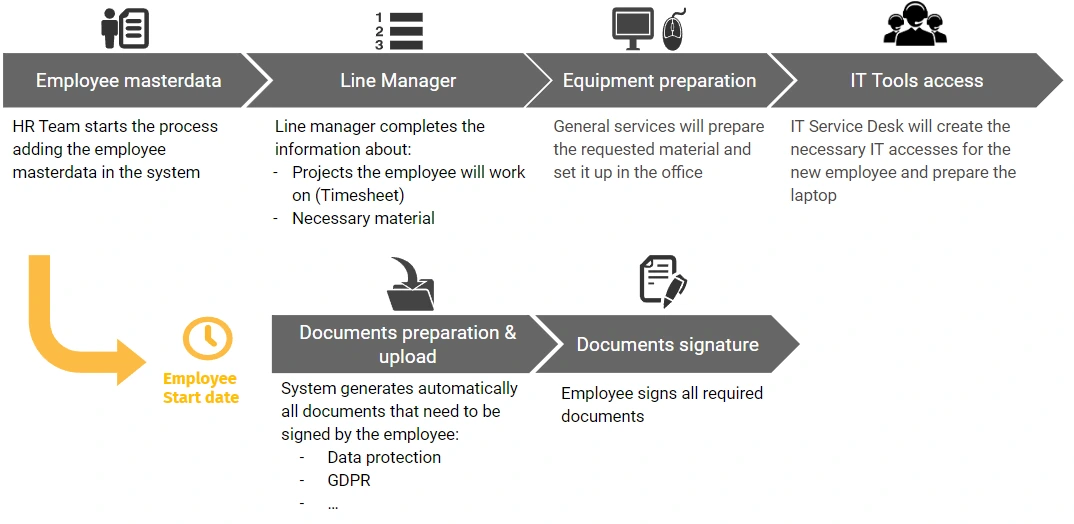
How automation improves the employee onboarding process
Every new hire follows the same structured, personalised path — documentation handled automatically, access provisioned before day one, training tailored to role, and HR systems updated without manual re-entry.
Automated task scheduling & reminders
BPA triggers the full onboarding workflow automatically at offer acceptance — assigning tasks to HR, IT, and the line manager simultaneously, scheduling reminders for upcoming deadlines, and tracking completion status in real time. No task is missed, no stakeholder is forgotten, and the new hire arrives prepared.
Automated document management & IDP
BPA and IDP generate and distribute onboarding documents electronically — employment contracts, compliance forms, tax declarations, and policy acknowledgements. Documents are e-signed, IDP verifies submitted documents for completeness and accuracy, and all records are stored automatically without manual paperwork handling.
Personalised onboarding plans
BPA generates personalised onboarding checklists, training modules, and orientation resources automatically based on the new hire’s role, department, and location. Every new hire receives a tailored plan — ensuring they get the information and access relevant to their specific position from the first day.
Automated access provisioning
RPA automates the provisioning of system access credentials, application permissions, and IT resources based on the new hire’s role — ensuring they arrive on day one with everything they need. Access is configured consistently and securely, with no dependency on manual IT requests or forgotten approvals.
HR systems integration
BPA synchronises employee masterdata automatically across HR management systems, payroll, timesheet tools, and other platforms — eliminating manual data re-entry and ensuring consistency from the first day. If the organisation uses a dedicated HR tool, a customised integration is added to the workflow.
Feedback & continuous improvement
Automated surveys are sent to the new hire and their manager at key onboarding milestones — end of week one, end of month one — collecting structured feedback on the onboarding experience. Responses are analysed automatically and used to refine the onboarding process over time.
Based on industry benchmarks for HR process automation. Actual results vary by organisation.
Other HR automation use cases
Ready to transform your operations?
Schedule a free consultation with our automation specialists.
We’ll analyze your current processes and show you exactly where automation can make the biggest impact.
No commitment. No generic demos. Just a real conversation about your operation.
FREE BPA CONSULTATION
Find out where automation can make the biggest impact on your operations
In a free 30-minute session, one of our certified BPA consultants will analyse your current back-office workflows and show you exactly where automation can reduce costs, eliminate manual effort, and strengthen compliance — with no commitment and no generic demos.