
Employee offboarding automation
Departures handled smoothly. Access revoked securely. Nothing left open.
Employee offboarding is a compliance and security-critical process that is routinely underestimated — and managed poorly. Done manually, it means scattered checklists, forgotten system access that remains active weeks after departure, paperwork completed late, and exit interviews that never get scheduled. Automated, it becomes a structured workflow that triggers immediately on notice of departure — covering documentation, asset return, access revocation, exit interviews, and HR system updates — with nothing missed and a complete audit trail maintained throughout.
Manual vs automated employee offboarding
Most organisations still manage offboarding through informal checklists and email coordination — creating security risks, compliance gaps, and a poor departure experience for employees who are often still ambassadors for the brand.
Without automation
What the manual process typically looks like
- Offboarding initiated manually — no structured trigger, tasks assigned informally with no tracking
- System access revocation done ad hoc — former employees often retain access for days or weeks after departure
- Offboarding paperwork completed on paper or by email — documents frequently delayed, lost, or filed incorrectly
- Asset return tracked informally — equipment frequently not recovered, creating financial and data security exposure
- Exit interviews scheduled manually — often not conducted at all, valuable feedback lost
- HR systems updated manually — payroll, directory, and access systems updated inconsistently and slowly
With automation
What changes when you automate
- Offboarding workflow triggered automatically at notice of departure — all teams assigned tasks with deadlines
- System access revocation initiated automatically on departure date — no manual IT request required
- Offboarding documents generated electronically — resignation letters, termination agreements, and compliance forms managed automatically
- Asset return tracked through structured workflow — reminders sent automatically until confirmed complete
- Exit interviews scheduled and administered automatically — feedback collected and analysed without manual effort
- HR systems updated automatically — payroll, directory, and access systems synchronised on departure date
Exclusive content
Access the full use case
Fill in the form to unlock this resource — no spam, only content relevant to your operations.
Employee offboarding automation
Departures handled smoothly. Access revoked securely. Nothing left open.
Employee offboarding is a compliance and security-critical process that is routinely underestimated — and managed poorly. Done manually, it means scattered checklists, forgotten system access that remains active weeks after departure, paperwork completed late, and exit interviews that never get scheduled. Automated, it becomes a structured workflow that triggers immediately on notice of departure — covering documentation, asset return, access revocation, exit interviews, and HR system updates — with nothing missed and a complete audit trail maintained throughout.
Manual vs automated employee offboarding
Most organisations still manage offboarding through informal checklists and email coordination — creating security risks, compliance gaps, and a poor departure experience for employees who are often still ambassadors for the brand.
Without automation
What the manual process typically looks like
- Offboarding initiated manually — no structured trigger, tasks assigned informally with no tracking
- System access revocation done ad hoc — former employees often retain access for days or weeks after departure
- Offboarding paperwork completed on paper or by email — documents frequently delayed, lost, or filed incorrectly
- Asset return tracked informally — equipment frequently not recovered, creating financial and data security exposure
- Exit interviews scheduled manually — often not conducted at all, valuable feedback lost
- HR systems updated manually — payroll, directory, and access systems updated inconsistently and slowly
With automation
What changes when you automate
- Offboarding workflow triggered automatically at notice of departure — all teams assigned tasks with deadlines
- System access revocation initiated automatically on departure date — no manual IT request required
- Offboarding documents generated electronically — resignation letters, termination agreements, and compliance forms managed automatically
- Asset return tracked through structured workflow — reminders sent automatically until confirmed complete
- Exit interviews scheduled and administered automatically — feedback collected and analysed without manual effort
- HR systems updated automatically — payroll, directory, and access systems synchronised on departure date
What employee offboarding involves
Employee offboarding is the process of managing the transition of employees out of the organisation when they leave employment. It involves completing necessary paperwork, returning company assets, deactivating access to systems and facilities, conducting exit interviews, and ensuring a positive farewell experience for departing employees. Effective offboarding ensures that employees leave on good terms and that the organisation maintains security and compliance throughout the departure process.
Beyond the human dimension, offboarding is a significant security and compliance obligation. An employee who retains active system access after departure represents a real data security risk. An improperly handled offboarding creates legal exposure. Automated, every step of the departure process is executed on schedule — with a complete, timestamped audit trail available for compliance review at any time.
The employee offboarding workflow
From notice of departure to final system update — every step of the process, mapped end to end.
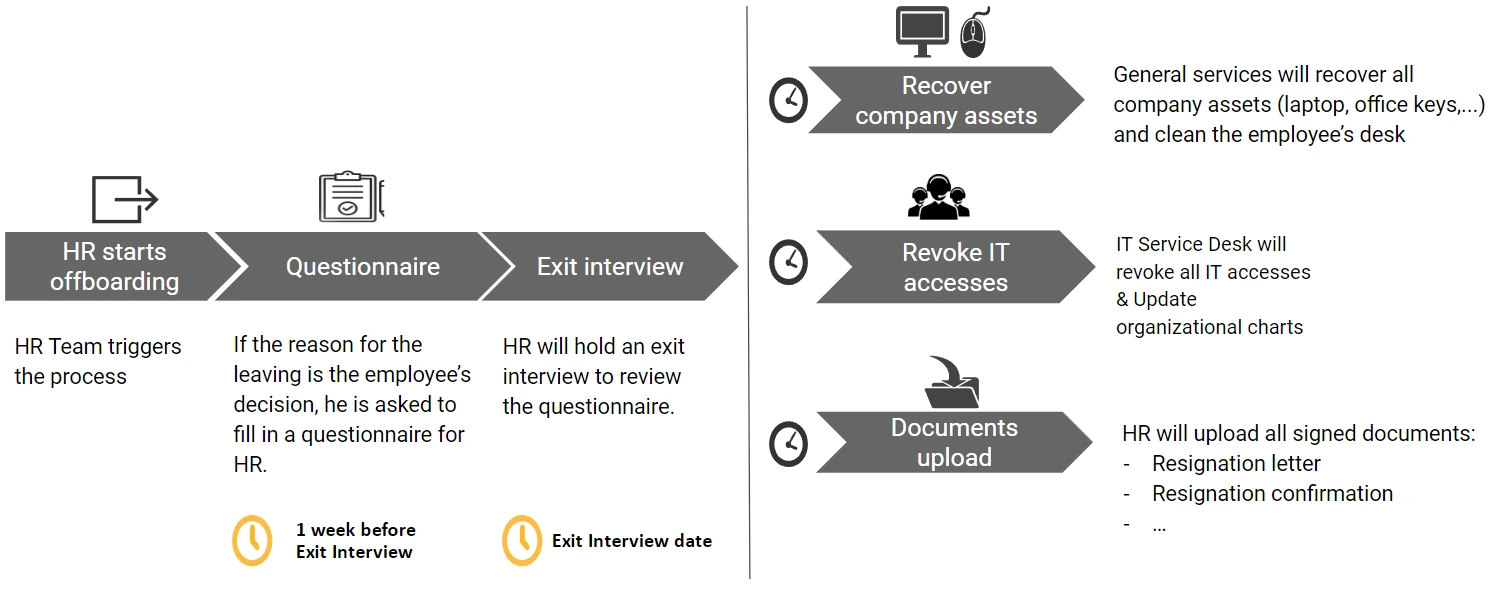
How automation improves the employee offboarding process
Every departure follows the same structured, compliant path — documentation handled automatically, access revoked on schedule, assets tracked, exit feedback collected, and HR systems updated without manual coordination.
Automated checklist & task management
BPA triggers a comprehensive offboarding checklist automatically at notice of departure — assigning tasks to HR, IT, the line manager, and the departing employee with individual deadlines. Every step is tracked in real time, with automated reminders sent until each task is confirmed complete. Nothing is left to informal memory or ad hoc follow-up.
Electronic document management
BPA automates the generation and distribution of all offboarding documentation — resignation acknowledgements, termination agreements, reference letter requests, and compliance forms. Documents are digitised, e-signed, and stored securely in electronic repositories without manual paperwork handling or filing delays.
Automated access revocation
BPA initiates the revocation of system access, application credentials, and facility permissions automatically on the departure date — with no dependency on manual IT requests. Access is revoked consistently and completely across all platforms, eliminating the security risk of former employees retaining active credentials after departure.
Automated exit interviews
Exit interviews are scheduled and administered automatically — with the departing employee receiving a structured feedback form at the appropriate point in the offboarding process. Responses are collected, anonymised where appropriate, and analysed automatically to identify patterns in employee engagement, retention, and organisational culture.
Asset return tracking
Company assets — laptops, phones, access cards, and other equipment — are tracked through a structured return workflow. Automated reminders are sent to the departing employee and line manager at predefined intervals until return is confirmed, protecting the organisation from unrecovered equipment and the data security risk it represents.
HR systems synchronisation
All HR systems — payroll, employee directory, access management, and benefits platforms — are updated automatically on the departure date. Final payroll calculations, accrued leave settlements, and system deactivations are executed without manual data entry, ensuring compliance with record-keeping requirements and a clean, complete departure.
Based on industry benchmarks for HR process automation. Actual results vary by organisation.
Other HR automation use cases
Ready to transform your operations?
Schedule a free consultation with our automation specialists.
We’ll analyze your current processes and show you exactly where automation can make the biggest impact.
No commitment. No generic demos. Just a real conversation about your operation.
FREE BPA CONSULTATION
Find out where automation can make the biggest impact on your operations
In a free 30-minute session, one of our certified BPA consultants will analyse your current back-office workflows and show you exactly where automation can reduce costs, eliminate manual effort, and strengthen compliance — with no commitment and no generic demos.