
Employee performance appraisal automation
Objective evaluations. Structured feedback. Performance cycles that actually happen on time.
Performance appraisals are one of the most important — and most frequently postponed — HR processes in any organisation. Managed manually, they involve chasing managers for overdue reviews, collecting feedback inconsistently, and producing evaluations that vary widely in quality and objectivity. Automated, it becomes a structured, timely workflow: data collected from multiple sources, feedback gathered through 360-degree surveys, evaluations scored consistently against predefined KPIs, and review meetings scheduled and tracked automatically — with actionable performance insights delivered without manual report compilation.
Manual vs automated performance appraisal
Most organisations still manage performance reviews through manual scheduling, spreadsheet-based scoring, and email-based feedback collection — producing evaluations that are late, inconsistent, and insufficiently informed by data.
Without automation
What the manual process typically looks like
- Review cycles announced but frequently delayed — HR teams chase managers for overdue appraisals for weeks
- Performance data collected manually from disparate sources — incomplete, inconsistent, and time-consuming
- Feedback gathered informally by email — often from a limited set of contacts with no structured process
- Evaluations scored subjectively — criteria applied inconsistently across managers and departments
- Review meetings scheduled manually — frequently postponed, action plans rarely followed up
- No consolidated performance reporting — managers lack real-time insight into team performance trends
With automation
What changes when you automate
- Review cycles triggered automatically on schedule — reminders sent to managers and employees with clear deadlines
- Performance data aggregated automatically from project tools, customer feedback systems, and HR platforms
- 360-degree feedback surveys distributed automatically — responses collected from peers, subordinates, and clients
- Evaluations scored consistently using predefined KPIs and benchmarks — bias reduced, objectivity enforced
- Review meetings scheduled automatically — action plan tracking and follow-up reminders sent without manual effort
- Performance analytics generated automatically — dashboards and trend reports available in real time
Exclusive content
Access the full use case
Fill in the form to unlock this resource — no spam, only content relevant to your operations.
Employee performance appraisal automation
Objective evaluations. Structured feedback. Performance cycles that actually happen on time.
Performance appraisals are one of the most important — and most frequently postponed — HR processes in any organisation. Managed manually, they involve chasing managers for overdue reviews, collecting feedback inconsistently, and producing evaluations that vary widely in quality and objectivity. Automated, it becomes a structured, timely workflow: data collected from multiple sources, feedback gathered through 360-degree surveys, evaluations scored consistently against predefined KPIs, and review meetings scheduled and tracked automatically — with actionable performance insights delivered without manual report compilation.
Manual vs automated performance appraisal
Most organisations still manage performance reviews through manual scheduling, spreadsheet-based scoring, and email-based feedback collection — producing evaluations that are late, inconsistent, and insufficiently informed by data.
Without automation
What the manual process typically looks like
- Review cycles announced but frequently delayed — HR teams chase managers for overdue appraisals for weeks
- Performance data collected manually from disparate sources — incomplete, inconsistent, and time-consuming
- Feedback gathered informally by email — often from a limited set of contacts with no structured process
- Evaluations scored subjectively — criteria applied inconsistently across managers and departments
- Review meetings scheduled manually — frequently postponed, action plans rarely followed up
- No consolidated performance reporting — managers lack real-time insight into team performance trends
With automation
What changes when you automate
- Review cycles triggered automatically on schedule — reminders sent to managers and employees with clear deadlines
- Performance data aggregated automatically from project tools, customer feedback systems, and HR platforms
- 360-degree feedback surveys distributed automatically — responses collected from peers, subordinates, and clients
- Evaluations scored consistently using predefined KPIs and benchmarks — bias reduced, objectivity enforced
- Review meetings scheduled automatically — action plan tracking and follow-up reminders sent without manual effort
- Performance analytics generated automatically — dashboards and trend reports available in real time
What employee performance appraisal involves
Employee performance appraisal — also known as performance review or performance evaluation — is the process of assessing an employee’s job performance, accomplishments, strengths, and areas for improvement. It provides an opportunity for managers and employees to discuss goals, expectations, feedback, and career development. Effective appraisals foster transparency, alignment, and continuous improvement.
Done well, performance appraisals are one of the most powerful tools available for improving organisational performance, retaining top talent, and identifying development needs. Done poorly — inconsistently, late, or without adequate data — they create frustration and erode trust. Automated, the process delivers structured, objective, timely appraisals at scale — consistently across the entire organisation, every cycle.
The performance appraisal workflow
From performance data collection to completed review and action plan — every step of the process, mapped end to end.
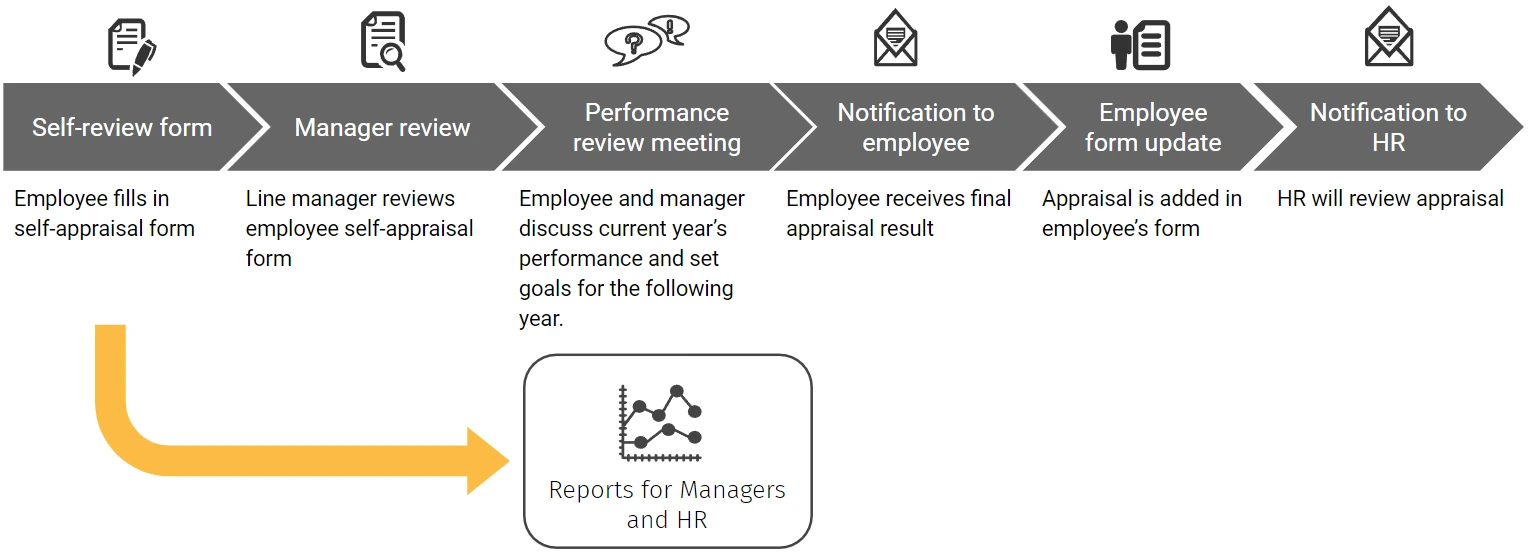
How automation improves the performance appraisal process
Every appraisal cycle follows the same structured, data-driven path — performance data collected automatically, feedback gathered from all relevant stakeholders, evaluations scored consistently, and review meetings tracked through to action plan completion.
Automated performance data collection
BPA aggregates performance metrics, project outcomes, customer feedback, and accomplishments automatically from connected systems — project management tools, CRM, HR platforms, and employee surveys. Comprehensive, real-time performance data is available to reviewers without manual collection effort.
Objective performance evaluation & KPI scoring
BPA applies predefined evaluation criteria, KPIs, and performance benchmarks consistently across all appraisals — reducing the subjectivity and bias that characterise manual scoring. Every employee is assessed against the same standards, enabling fair comparison and defensible promotion and development decisions.
360-degree feedback automation
Feedback surveys are distributed automatically to a structured set of stakeholders — peers, subordinates, managers, and where relevant, clients — through online forms with predefined response scales. Responses are collected, aggregated, and anonymised automatically, providing a holistic view of each employee’s performance and interpersonal effectiveness.
Review workflow management & scheduling
BPA automates the scheduling of performance review meetings, sends reminders to managers and employees, and tracks the status of each review across the organisation. Escalation is triggered automatically for overdue reviews, and action plans agreed during the meeting are tracked through to completion with automated follow-up reminders.
Performance analytics & reporting
BPA analyses performance data automatically across the organisation — identifying trends, high performers, development needs, and correlation between team performance and organisational outcomes. Managers and HR receive real-time dashboards and consolidated performance reports without manual compilation effort.
Development plan & follow-up tracking
Development plans agreed during the review are documented automatically and tracked through structured workflows. Progress check-ins are scheduled at predefined intervals, and automated reminders are sent to both employee and manager — ensuring that the commitments made in the review room translate into concrete action, not forgotten intentions.
Based on industry benchmarks for HR process automation. Actual results vary by organisation.
Other HR automation use cases
Ready to transform your operations?
Schedule a free consultation with our automation specialists.
We’ll analyze your current processes and show you exactly where automation can make the biggest impact.
No commitment. No generic demos. Just a real conversation about your operation.
FREE BPA CONSULTATION
Find out where automation can make the biggest impact on your operations
In a free 30-minute session, one of our certified BPA consultants will analyse your current back-office workflows and show you exactly where automation can reduce costs, eliminate manual effort, and strengthen compliance — with no commitment and no generic demos.