
Securities transfer automation
Precise execution. Real-time compliance. Zero reconciliation errors.
Securities transfer is one of the most compliance-critical operations in banking — moving ownership of stocks, bonds, or funds between parties requires accuracy, traceability, and strict adherence to regulatory constraints. Managed manually, it creates verification bottlenecks, reconciliation errors, and audit gaps. Automated, it becomes a structured end-to-end workflow — from transfer request to settlement and reporting — with no manual handoffs and no step missed.
Manual vs automated securities transfer
Most banks still process securities transfers through manual verification, email-based counterparty communication, and disconnected depository systems — creating delays, reconciliation errors, and compliance exposure.
Without automation
What the manual process typically looks like
- Transfer requests submitted by email or paper — manually logged and verified by operations staff
- Document validation done one by one with no automated completeness or ownership check
- Compliance review performed manually — inconsistent across officers and transaction types
- Counterparty communication handled via email or phone — slow and prone to miscommunication
- Depository system updates applied manually after execution — reconciliation errors are common
- Audit trail incomplete and scattered across systems — difficult to reconstruct for regulatory review
With automation
What changes when you automate
- Digital transfer requests captured automatically and routed to the correct team instantly
- IDP validates submitted documents in real time — ownership rights and completeness verified automatically
- Compliance checks triggered automatically — sanctions screening, KYC, and regulatory constraints verified
- Counterparty communication automated — institutions notified and confirmations captured in the workflow
- Depository system updated automatically upon execution — reconciliation performed without manual input
- Complete, timestamped audit trail generated at every step — ready for regulatory review at any time
Exclusive content
Access the full use case
Fill in the form to unlock this resource — no spam, only content relevant to your operations.
Securities transfer automation
Precise execution. Real-time compliance. Zero reconciliation errors.
Securities transfer is one of the most compliance-critical operations in banking — moving ownership of stocks, bonds, or funds between parties requires accuracy, traceability, and strict adherence to regulatory constraints. Managed manually, it creates verification bottlenecks, reconciliation errors, and audit gaps. Automated, it becomes a structured end-to-end workflow — from transfer request to settlement and reporting — with no manual handoffs and no step missed.
Manual vs automated securities transfer
Most banks still process securities transfers through manual verification, email-based counterparty communication, and disconnected depository systems — creating delays, reconciliation errors, and compliance exposure.
Without automation
What the manual process typically looks like
- Transfer requests submitted by email or paper — manually logged and verified by operations staff
- Document validation done one by one with no automated completeness or ownership check
- Compliance review performed manually — inconsistent across officers and transaction types
- Counterparty communication handled via email or phone — slow and prone to miscommunication
- Depository system updates applied manually after execution — reconciliation errors are common
- Audit trail incomplete and scattered across systems — difficult to reconstruct for regulatory review
With automation
What changes when you automate
- Digital transfer requests captured automatically and routed to the correct team instantly
- IDP validates submitted documents in real time — ownership rights and completeness verified automatically
- Compliance checks triggered automatically — sanctions screening, KYC, and regulatory constraints verified
- Counterparty communication automated — institutions notified and confirmations captured in the workflow
- Depository system updated automatically upon execution — reconciliation performed without manual input
- Complete, timestamped audit trail generated at every step — ready for regulatory review at any time
What securities transfer involves
Securities transfer is the process of moving ownership of financial assets — stocks, bonds, mutual funds, or other instruments — from one party to another. It involves updating ownership records in the depository system, verifying the legitimacy of the transaction, ensuring compliance with all applicable regulations, and confirming settlement to both parties. The process is triggered by events such as a sale or purchase of securities, inheritance, portfolio rebalancing, or the movement of assets between accounts or institutions.
Each transfer requires coordination between multiple internal teams — operations, compliance, risk — and external counterparties. Done manually, the process is slow, error-prone, and difficult to audit. Automated, it becomes a standardised, fully traceable workflow that reduces processing times, eliminates reconciliation errors, and ensures every regulatory requirement is met consistently.
The securities transfer workflow
From transfer request to settlement and reporting — every step of the process, mapped end to end.
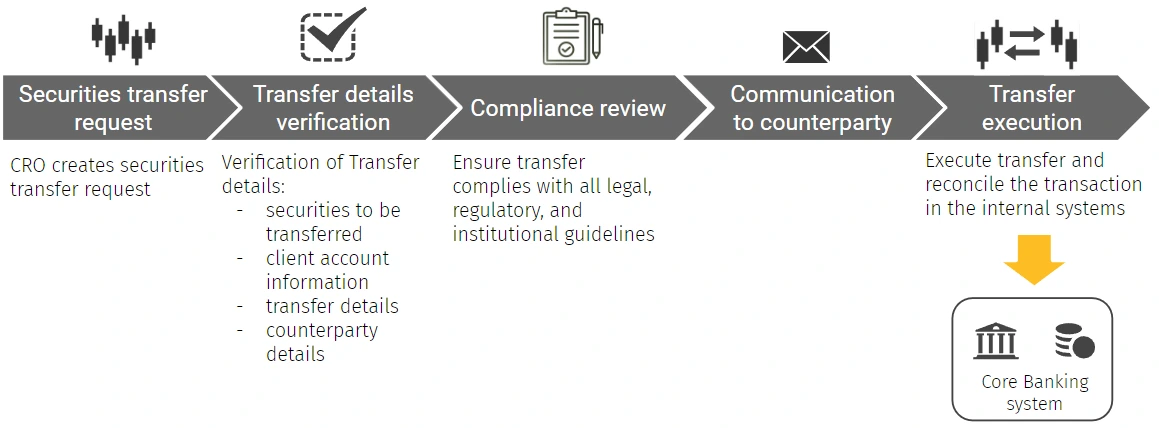
How automation improves the securities transfer process
Every transfer follows the same verified compliance and execution path — regardless of asset type, counterparty, or transaction size. No manual coordination, no reconciliation gaps, no audit trail missing.
Automated transfer request intake & IDP validation
Digital transfer request forms capture all required information upfront. Submitted documents — ownership proofs, transfer instructions, client identification — are validated automatically using IDP, flagging missing or inconsistent data before they reach the compliance team.
Automated compliance & regulatory checks
Compliance verification — including ownership rights, sanctions screening, and regulatory constraints — is triggered automatically upon receiving a transfer request. Non-compliant transfers are flagged and escalated for human review before any execution proceeds.
Automated counterparty communication
Once client verification is complete, counterparty institutions are notified automatically with the transfer details and instructions. Confirmations and responses are captured directly in the workflow — eliminating email-based coordination and the delays and miscommunications it creates.
Automated transfer execution & depository update
RPA interfaces directly with internal and external depository systems to execute the transfer accurately — updating ownership records, moving securities to the correct accounts, and reconciling positions automatically without any manual re-entry across disconnected systems.
Automated settlement confirmation & client notification
Upon completion, settlement confirmation is sent automatically to both parties — including transaction details, securities transferred, and associated fees. Clients receive real-time status updates throughout the process, reducing inbound queries to the operations team.
Automated reconciliation & audit trail
Transfer records are reconciled automatically across all internal systems upon settlement. Portfolio records and client accounts are updated in real time. Every action is timestamped and logged automatically — creating a complete, audit-ready record for regulatory and internal review.
Based on industry benchmarks for banking securities operations automation. Actual results vary by organisation.
Other banking automation use cases
Ready to transform your operations?
Schedule a free consultation with our automation specialists.
We’ll analyze your current processes and show you exactly where automation can make the biggest impact.
No commitment. No generic demos. Just a real conversation about your operation.
FREE BPA CONSULTATION
Find out where automation can make the biggest impact on your operations
In a free 30-minute session, one of our certified BPA consultants will analyse your current back-office workflows and show you exactly where automation can reduce costs, eliminate manual effort, and strengthen compliance — with no commitment and no generic demos.