
Funds transfer automation
Faster approvals. Airtight compliance. Zero fraud gaps.
Funds transfer approval is one of the most risk-sensitive operations in banking — every transaction must be verified, screened for compliance, assessed for fraud risk, and approved before funds move. Managed manually, it creates bottlenecks, inconsistent risk reviews, and exposure to fraud and regulatory breaches. Automated, it becomes a structured, real-time workflow — from transfer request to execution and reporting — with every check enforced and every action traceable.
Manual vs automated funds transfer approval
Most banks still manage funds transfer approvals through manual verification steps, email-based routing, and disconnected compliance checks — creating delays, inconsistent risk decisions, and exposure to fraud and regulatory breaches.
Without automation
What the manual process typically looks like
- Transfer requests submitted by clients or staff — manually logged and routed for verification
- Sender and recipient details verified manually against internal databases — slow and error-prone
- AML, KYC, and sanctions checks performed manually — inconsistent across officers and transaction types
- Risk assessment done case by case with no standardised criteria or automated anomaly detection
- Approval routing managed by email — high-priority transfers treated the same as low-risk ones
- Audit trail scattered across systems — difficult to reconstruct for compliance or fraud investigations
With automation
What changes when you automate
- Transfer requests captured digitally — sender and recipient details validated automatically in real time
- AML, KYC, and sanctions screening triggered automatically — suspicious transactions flagged instantly
- Risk assessment run automatically against predefined parameters — anomalies detected and escalated
- Approval routing automated based on transaction risk level — urgent transfers prioritised automatically
- Execution triggered automatically upon final approval — accounts updated and confirmation sent
- Complete audit trail generated automatically at every step — ready for compliance and fraud review
Exclusive content
Access the full use case
Fill in the form to unlock this resource — no spam, only content relevant to your operations.
Funds transfer automation
Faster approvals. Airtight compliance. Zero fraud gaps.
Funds transfer approval is one of the most risk-sensitive operations in banking — every transaction must be verified, screened for compliance, assessed for fraud risk, and approved before funds move. Managed manually, it creates bottlenecks, inconsistent risk reviews, and exposure to fraud and regulatory breaches. Automated, it becomes a structured, real-time workflow — from transfer request to execution and reporting — with every check enforced and every action traceable.
Manual vs automated funds transfer approval
Most banks still manage funds transfer approvals through manual verification steps, email-based routing, and disconnected compliance checks — creating delays, inconsistent risk decisions, and exposure to fraud and regulatory breaches.
Without automation
What the manual process typically looks like
- Transfer requests submitted by clients or staff — manually logged and routed for verification
- Sender and recipient details verified manually against internal databases — slow and error-prone
- AML, KYC, and sanctions checks performed manually — inconsistent across officers and transaction types
- Risk assessment done case by case with no standardised criteria or automated anomaly detection
- Approval routing managed by email — high-priority transfers treated the same as low-risk ones
- Audit trail scattered across systems — difficult to reconstruct for compliance or fraud investigations
With automation
What changes when you automate
- Transfer requests captured digitally — sender and recipient details validated automatically in real time
- AML, KYC, and sanctions screening triggered automatically — suspicious transactions flagged instantly
- Risk assessment run automatically against predefined parameters — anomalies detected and escalated
- Approval routing automated based on transaction risk level — urgent transfers prioritised automatically
- Execution triggered automatically upon final approval — accounts updated and confirmation sent
- Complete audit trail generated automatically at every step — ready for compliance and fraud review
What funds transfer approval involves
Funds transfer approval is the process by which financial institutions review and authorise the movement of funds between accounts — whether between customers of the same institution, between different institutions, or across borders. Every transfer must be verified for accuracy, screened for compliance with AML, KYC, and sanctions regulations, assessed for fraud risk, and approved through the appropriate internal workflow before funds are disbursed.
The process is especially critical for high-value or cross-border transfers, where the risk of fraud, money laundering, and regulatory non-compliance is highest. Done manually, it is slow, inconsistent, and difficult to audit. Automated, it becomes a real-time, standardised process that reduces processing times, enforces every compliance check, and maintains a complete record of every decision made.
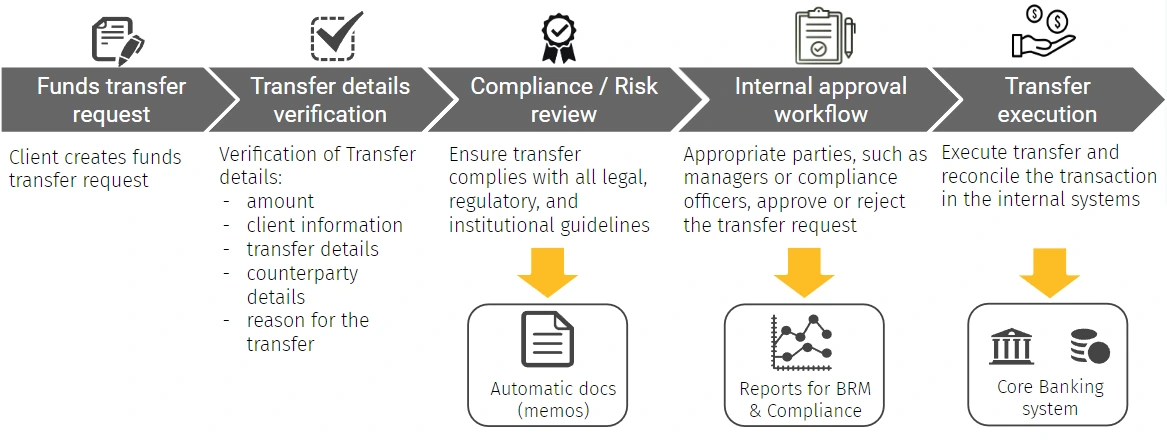
The funds transfer approval workflow
From transfer request to execution and reporting — every step of the process, mapped end to end.
How automation improves the funds transfer approval process
Every transfer follows the same verified compliance and risk path — regardless of amount, destination, or channel. Faster approvals, consistent screening, and no compliance gap at any stage.
Automated data verification & request intake
BPA validates sender and recipient details automatically against internal databases and external networks — including SWIFT and ACH — ensuring accuracy before the transfer enters the approval workflow. Manual data entry errors are eliminated at the point of capture, not discovered downstream.
Real-time AML, KYC & sanctions screening
Compliance checks — AML screening, KYC verification, and sanctions list matching — are triggered automatically upon receiving a transfer request. Transactions that meet suspicious activity criteria are flagged instantly and routed for human review before any funds move, with no manual initiation required.
Automated risk assessment & anomaly detection
Risk assessment is run automatically by cross-referencing transfer details with predefined risk parameters — transaction limits, account behaviour patterns, and counterparty risk profiles. Anomalies are detected and escalated automatically, ensuring that high-risk transfers receive the appropriate level of scrutiny before approval.
Automated approval routing & prioritisation
Transfer requests are routed automatically to the appropriate approver based on transaction risk level, amount, and type. High-priority or time-sensitive transfers are escalated automatically — ensuring that urgent transactions are not held in a generic queue alongside routine approvals.
Automated execution & instant notifications
Upon final approval, funds are transferred automatically — sender and recipient account balances updated in real time with no manual re-entry. All stakeholders receive instant notifications of approvals, rejections, or required actions, keeping every party informed throughout the process.
Automated audit trail & compliance reporting
Every action in the approval process — verification, compliance check, risk assessment, approval decision, execution — is logged automatically with full timestamps. Real-time compliance reports are generated automatically, providing a complete audit trail ready for regulatory review, internal audit, or fraud investigation at any time.
Based on industry benchmarks for banking funds transfer automation. Actual results vary by organisation.
Other banking automation use cases
Ready to transform your operations?
Schedule a free consultation with our automation specialists.
We’ll analyze your current processes and show you exactly where automation can make the biggest impact.
No commitment. No generic demos. Just a real conversation about your operation.
FREE BPA CONSULTATION
Find out where automation can make the biggest impact on your operations
In a free 30-minute session, one of our certified BPA consultants will analyse your current back-office workflows and show you exactly where automation can reduce costs, eliminate manual effort, and strengthen compliance — with no commitment and no generic demos.